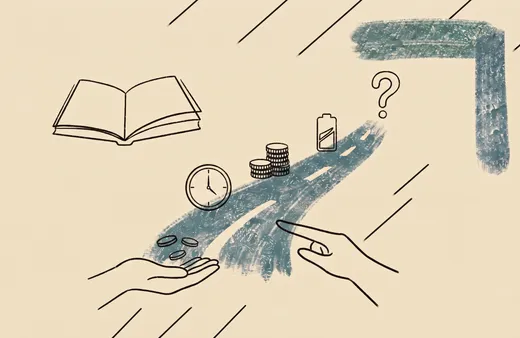
How Much Are You Willing to Spend?
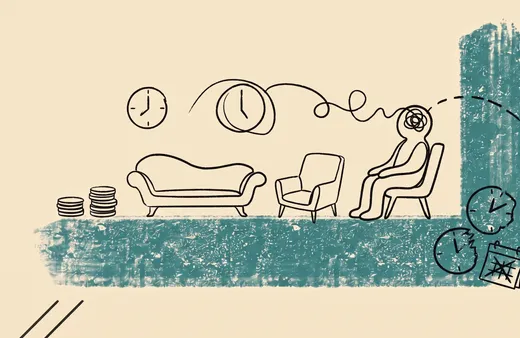
The cost and time of psychoanalysis aren't just about money — too high a price inflates expectations, too low devalues the work itself.
Short pieces on psychoanalysis, psychotherapy, and inner life.
The cost and time of psychoanalysis aren't just about money — too high a price inflates expectations, too low devalues the work itself.
Language structures the psyche from birth — why working in analysis in your native language reaches what gets lost in translation.
Freud compared the psyche to a “mystic writing pad” — what we've forgotten, it turns out, still remembers us.
Psychoanalysis works without diagnoses or labels — only the unique psychic reality of each person.
Psychoanalysis works not with the symptom itself, but with what it means for this particular person.
The method of free association, first proposed by Freud in 1892, remains the core of psychoanalysis today.
The history of psychoanalysis is itself a history of migration — starting with Freud himself.
Psychologist, psychiatrist, psychotherapist, psychoanalyst — what actually separates these specialists?
Every analysand arrives well-informed — but what does the analyst feel in that same moment?
Patrick Casement's book on how a psychoanalyst learns from every single patient.
Place, time, and payment: the psychoanalytic setting is itself a therapeutic instrument.
Silence in session isn't empty — it's one of the most telling tools an analysis has.
Slips of the tongue, forgetting, small everyday mistakes — not accidents, but a window onto the unconscious.
A seemingly trivial childhood memory can turn out to be a screen for something far more important.
Seven illnesses in which the psychoanalyst Alexander first recognised psychological causes.
A phobia is less a fear of an outside object than an answer to a threat inside the psyche.
Skin is the one visible organ where what happens deep in the psyche can surface.
Psychoanalysis has no concept of “the subconscious” — only the Unconscious, Preconscious, and Conscious.
Winnicott coined “the good enough mother” — and lifted the weight of having to be a perfect one.
A child's dream is, in Freud's words, “an undisguised fulfilment of a wish.”
Freud singled out dreams nearly everyone has had: of nakedness, of running late, of flying, of falling.
Freud himself asked when an analysis can really be considered finished.
Harold Searles described the unconscious ways one person can try to “drive another crazy.”
“A child tells itself through drawing” — Françoise Dolto on children's art in session.
Winnicott's “squiggle game” turns a scribble into a key to a child's inner world.
Freud's “Interpretation of Dreams” opened the dream as the royal road to the unconscious.
The Baby Observation method lets a clinician witness the development of the psyche from the very first days of life.
The first time a child sees their own reflection, they don't immediately recognize it as themselves — a key moment in psychic development, per Françoise Dolto.
Françoise Dolto created the "Green House" — a free space for families with young children that anyone can walk into without an appointment.