
A Note on the Mystic Writing-Pad, or What Is Our Psyche Like?
Most people know Freud for his discovery of the unconscious. In his short paper “A Note on the Mystic Writing-Pad,” he tries to explain how our psychical apparatus actually works.
What do you do when you need to hold on to an important event? Most likely, you write it down. It’s a convenient and effective method. As Freud puts it, “the surface which retains the notes… is a materialized portion of my mnemic apparatus.” Now you can be sure that, for as long as you need, your note won’t undergo the distortions it might have suffered in your memory. The only drawback: eventually that surface runs out of room, and you need a new one. If instead you wrote the event on a chalkboard, you could simply erase it and put something else in its place, endlessly.
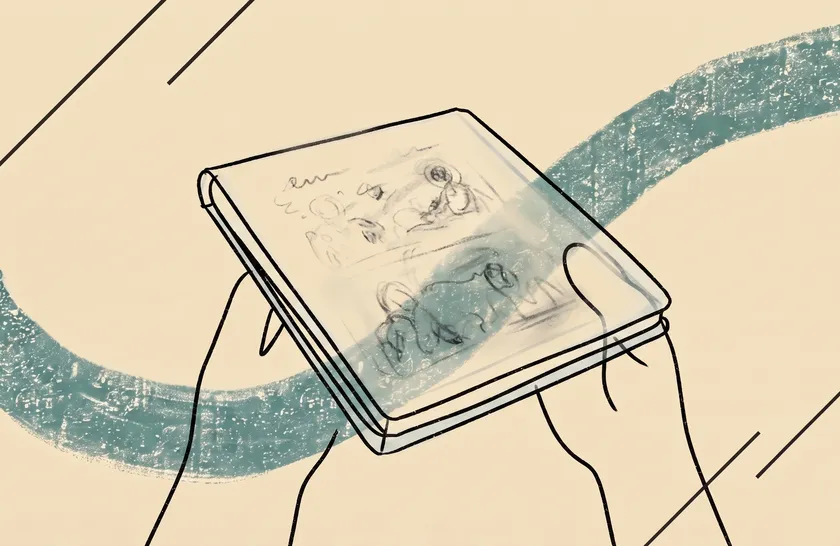
Our psyche, however, is built differently: it has an unlimited capacity to receive impressions and, at the same time, lays down lasting traces of them. To explain how the psychical apparatus manages both, Freud reaches for an analogy — the “mystic writing-pad,” a children’s toy. Looking closely at it, we see two layers: an upper one and a lower one. Where they touch, a mark or drawing appears — one that can be erased in an instant simply by separating the two layers. What do we see then? The surface is a “clean slate” again, while the lower layer still holds the traces of everything ever written on it.
Our psyche works on a similar principle, with one crucial difference from the mystic pad: the “reproduction” of a record that was once erased, or forgotten.
You could say that what we’ve forgotten still remembers us…