
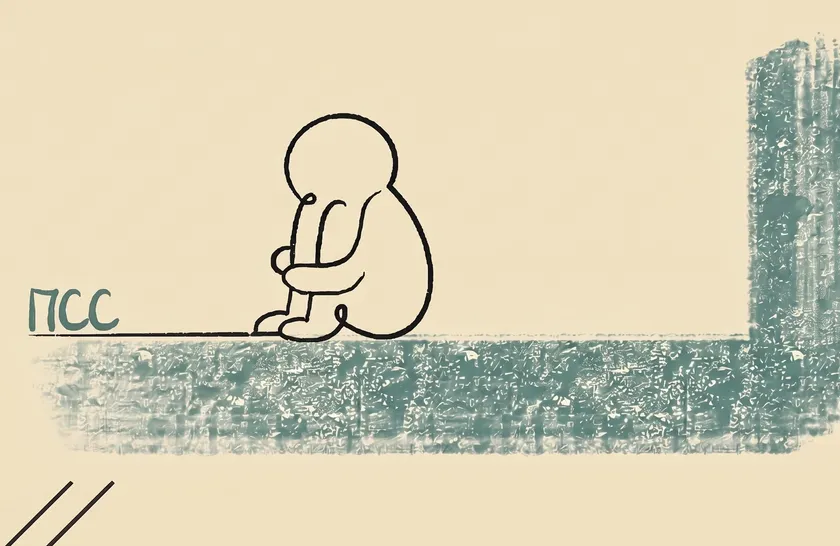
Phobias
A phobia — an obsessive, uncontrollable, irrational fear out of all proportion to what’s actually happening — is studied by specialists across many fields. Depending on the source, somewhere between 300 and 1,000 distinct phobias have been documented, though it would be more accurate to say there are as many phobias in the world as there are people. Practically anything can be feared — it’s hard to imagine an object or phenomenon that couldn’t become the target of a phobia.
The psychoanalytic reading of a phobia relates first and foremost to a person’s inner world, treating it as part of the subject’s psychical structure — elements of the psyche that give the impression of having been displaced onto the outside world. “Decisive weight is given to fantasy, anxiety, and psychical conflict — especially the conflict between love and aggression (ambivalence).” Phobias serve both interpersonal and intrapsychic functions. In the classic cases described in the psychoanalytic literature, what stands out is the striking degree of condensation — a hallmark of every phobia.
A person suffering from a phobia is fully aware of how compulsive and painful the fear that grips them is. The intensity can range from mild discomfort to unbearable terror. The defining feature of a phobia is a compulsive avoidance of certain objects or situations. The fear can appear directly, on encountering the object, or simply at the thought of a possible encounter. The fear itself is nearly indescribable, its growth uncontrollable — yet it correlates with a danger that exists only in the person’s imagination.
Sometimes a person feels an overwhelming fear of certain objects, people, or animals, and often the cause turns out to lie in the words or actions of the people closest to them. A phobia gives symbolic form to the most frightening fantasies and sadistic wishes.
In his work, Freud held that phobias result from an excessive use of the defense mechanisms of repression and displacement, deployed to manage a hidden anxiety. In this way, the signals that trigger anxiety are pushed even deeper into the unconscious, and the fears are shifted onto neutral objects, events, or situations — ones easier to deal with, and so easier to control. Freud recognized that a phobia isn’t simply the fear of an external object or situation one could just walk away from — it’s a response to a danger that exists within the psyche itself.
Freud’s views here sit close to the philosophical tradition. Both Kierkegaard and Freud clearly saw the need to distinguish “fear” from “anxiety,” holding that fear is a reaction to a specific danger, while anxiety is a reaction to an undefined, unknown one. Freud identified three basic forms of neurotic anxiety: “free-floating” anxiety, ready to attach itself at any moment to a suitable internal or external object; phobic reactions; and the fear that arises in severe neuroses and hysteria. “A phobia can be compared to a trench dug against an external danger — which is now represented by the fear-inducing libido itself. The weakness of this system of defense in phobias lies, of course, in the fact that a fortress so heavily reinforced on the outside remains open to attack from within. The projection of libidinal danger outward can never fully succeed.”