
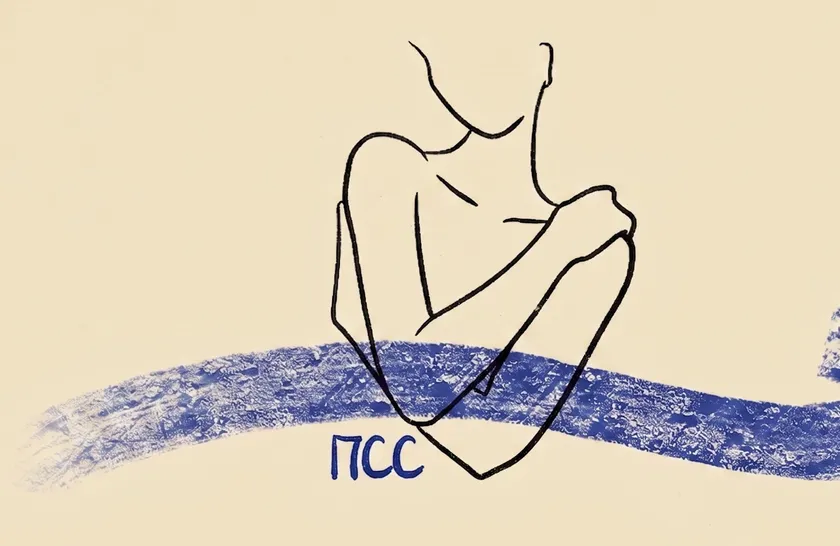
Skin in Psychoanalysis
From the moment of birth, every person begins building a unique experience of their own body and their own skin. In the first minutes of life, a newborn is placed directly against its mother’s body. From that point on, the child is touched, held, and kept in near-constant tactile contact. Through a complex set of psychical processes, they gradually learn to tell inside from outside, to sense where the boundaries of their body lie, and to become aware of their own “I,” separating it from what is not-I.
There’s a wide range of skin conditions — dermatitis, eczema, psoriasis, acne, rashes, allergies, and more. Imperfections of the skin stir up all kinds of emotion and feeling. Closer examination often reveals that skin conditions are connected to traumatic events in a person’s life. People struggling with psychical difficulties and people struggling with skin conditions have a great deal in common — each has “an exceptional relationship with their body and with their illness.” What sets skin apart is that it’s the one organ that’s actually visible.
In his research, Freud found that there’s no clean boundary between the psychical and the somatic. The two constantly overlap and reshape one another, and “the result is a new and more complex unity, whose components are heterogeneous and inseparable from each other, because the new structure they form is something more than the sum of its parts.”
An analyst tries to help the analysand understand what’s happening in their inner world — under the skin — and exactly what has been projected onto the body, “wrapping” it in the warm sweater of acceptance. In psychoanalysis, what matters isn’t the illness itself, but the person living with it.