
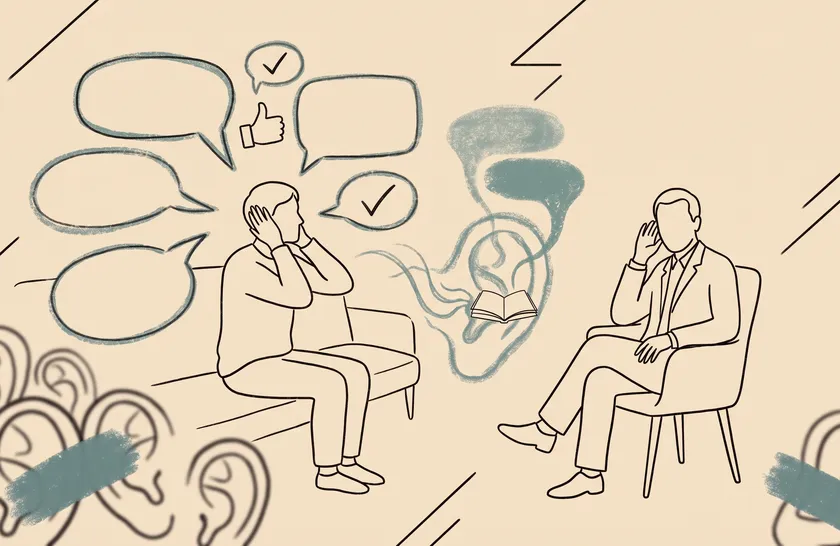
Being Heard in Order to Hear Yourself
“People can live their whole lives without listening to themselves, as if they were deaf. Some even die without ever having listened to themselves. An endless deafness to their own speech and to their own body — a body that doesn’t just speak, but screams. A deafness that is reason enough to justify psychoanalysis. If it still needs justifying at all” (a quote from the film Adieu, Lacan).
Every one of us has tried to get our feelings and experiences across to the people close to us, only to get ready-made “instructions” in return, advice from someone else’s life that doesn’t fit, or stock phrases like “I understand you” and “it’ll all work out.” At worst, what we share is dismissed or criticized.
In psychoanalysis, the phrase “being heard in order to hear yourself” captures a fundamental principle of the therapeutic process. From a psychoanalytic point of view, our psyche takes shape in relationships with a “Significant Other.” If, in the past, difficult experiences found no safe response, the affects were split off and repressed into the unconscious. Repression is the psyche’s natural defense.
The analytic space is a unique place where you can set down suppressed anxieties, chaotic thoughts, and feelings that haven’t yet taken shape. The well-known psychoanalyst Haydée Faimberg says that “listening has one further consequence: by listening to how the analyst has heard them, the patient, step by step, gains the ability to listen to themselves.” Saying “inappropriate material” out loud, and having the psychoanalyst accept it without judgment, lets a person feel their words take on a new form and meaning — psychic tension eases, and they are able to hear themselves. Listening to what has not been said is perhaps the hardest thing of all, but it is the only thing that can set us free.
Having reclaimed the right to their own feelings, anyone can come to treat themselves with respect and with attention to their inner world.